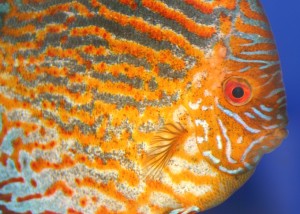
Tropical Fish Hybridization

Posted by: Jim in Fish No Comments »

We see a lot of examples of hybridization (the mating of two different species) in the commercial tropical fish world these days.  One of the oldest examples of this is the commercially available varieties of platties, mollies and swordtails.  Most of these are the result of the crossing of, in many cases, not just two but multiple species.

The question is whether this is the “right” thing to do.  Is it appropriate to take two species that would not likely meet each other in nature and mate them to produce a new creature?

Many would argue that this is unnatural and we have not right to do this.  Still others would say that there are enough beautiful fish occurring naturally and there is no need to mix species.

On the other hand, some would say that there is no harm being done and in fact, there are some benefits.  The results are unique and, in the eyes of many, beautiful new tropical fish.  The resultant strains are intended to be kept in aquariums so there is no “contamination” of nature and they are often commercially profitable.

Ah Ha!  Perhaps that is the real problem!  Certain people think that these crosses are exploiting nature for commercial gain.  To those folks, I would suggest that while your cause may be a noble one, that train has left the station and will not be returning.  The examples of these commercial cross-breedings are too numerous to list here: everything from mules to various fruits and vegetables are being produced on a major scale and it is unlikely that it will stop.

There are dozens of other arguments both for and against hybridization of tropical fish (and other living things) that I haven’t even touched on.  The truth is that I haven’t really scratched the surface of this issue, but the bottom line for me is that the hybrids do no harm and they are going to be done by someone, somewhere so why make a big deal about it?

I personally choose not to do it and where I know about it, not to purchase the results, but I also recognize the attraction for other people and acknowledge there right to pursue that endeavor.

What do you think?  Should people continue to create hybrid tropical fish and other animals (and plants)?  Please leave a comment below.

Livebearers – Advanced Tropical Fish?

Posted by: Jim in Fish No Comments »

Many people think of livebearers as beginner’s fish.  It is certainly true that many new aquarists start out raising guppies, platties, mollies or swordtails and their reputation as being an easy fish to raise is certainly well deserved but there are two points that should be noted.

The first is that there are many aspects to raising livebearers that can be challenging.  If one gets into breeding these fish and developing new color strains or fin configurations, their care becomes more complex.  Because these fish have the ability to store sperm in order to later reproduce without having a male present, it is necessary to separate genders at an early age if you are to have a successful selective breeding program.

The second point to note is that the above mentioned fish are not the only livebearing fish.  Other groups for consideration are:

Anablepidae – the eyes of these 4-eyed fish have two lobes, one for seeing above the water and one for seeing below.  They are large (25 to 30 cm) brackish water fish that are somewhat challenging to keep.  Another complicating factor is that these fish “rest” in the wild by sitting on the bottom in water shallow enough so that only their eyes protrude above the water.  Similar resting places must be provided in the aquarium.  This can be done by providing slate or rock perches placed slightly below the waterline.

Goodeidae – these “rarer” livebearers are relatively hardy and easy to keep.  They can be rather aggressive in a community setting and should be kept with other fish of like temperament.  These fish are viviparous which means the developing embryo is attached to the mother via a placenta-like structure.  As a result, the fry are better nourished and grow larger before birth.  This also means that typical broods are smaller.

Are you up to trying something different?  Try these unusual livebearers for a change.  Please leave a comment below.

Aquarium Lessons Learned

Posted by: Jim in General Care 1 Comment »

What are the takeaways from my guppy spawning?  There are probably a lot more, but here are five that should be helpful to most aquarium fans:

 1. To the extent possible always have a back-up tank available.  It could be a tank that you would otherwise use as a quarantine tank or even a suitable sized plastic tub, but you should always have something.  Have an extra heater and a mature filter as well.  A good way to keep a filter is to place an extra sponge filter in one of your aquariums.  It doesn’t have to be running there; it will be colonized by nitrifying bacteria just by being left in the tank for a few days.

 2. Don’t delay making the appropriate changes to a set-up.  If I had added some plants to the set-up, I probably would have more surviving fry.

3. Don’t put fish in a “temporary” tank except in an emergency.  Life happens and ”temporary” arrangements usually end up being much longer term than originally intended.  I once worked for an employer who brought in some trailers to provide temporary office space.  When I started working there the trailers had been in use for over 20 years.  Although usually not to the same extent, the same thing happens with aquariums. 

4. Always check your aquariums.  It only takes a minute to look and see if anything has gone wrong and it could save you a lot of frustration and perhaps prevent the loss of some fish.  If I hadn’t checked the guppies before going to work, I would not have known that the fry were there and by the time I got home in the evening, they would have most likely become snack food for the adults.

 5. Many fish and especially livebearers are very good at eating their own offspring.  If you are expecting a spawn and want to save and raise the fry, you should always provide plants or other hiding places in the aquarium so that the fry can have the best opportunity to escape their parents. 

I generally don’t recommend the use of breeding traps because they are generally small and can stress the expectant mother causing her to give birth prematurely. 

So plants are a good way to go.  You can also move the expectant mother to a separate tank to give birth so that you eliminate the possibility of the male preying on the fry.

What about you?  Have you learned any lessons from your fish?  So you have any tips to share?  Please leave a comment and join in the discussion.

Aquarium Surprise

Posted by: Jim in General Care No Comments »

A couple of weeks ago at our aquarium society meeting, I purchased a pair of black Moscow guppies at the auction.  I took them home and put them in a 2.5 gallon tank.  The tank had a mature sponge filter and a heater.

I had planned this to be a temporary location for the pair, but life being what it is; I just didn’t get around to it.  At one point in the last couple of weeks, I thought that the female looked a little large and might be pregnant, but I thought she couldn’t be very far along because she wasn’t that big.

Yesterday as I was getting ready to go to work, I noticed 4 fry swimming in the bottom of the tank and trying to stay away from the adults.  I quickly grabbed a small tank and siphoned off the fry and about half of the water from the adults’ tank.  I installed a sponge filter that I keep in one of my established tanks as an emergency back-up and a heater and now have a new grow-out tank.

I probably lost some fry to the adults before I discovered them as livebearers are noted for their tendency to make a meal out of their offspring.  But at least I was able to save four of them.

Have you ever had an unexpected occurrence with your aquariums?  What happened and what did you do?  Please leave a comment.

Small Children and Aquariums

Posted by: Jim in Feeding No Comments »

This is to continue the story of Rocky the goldfish.  Two days after his arrival, my granddaughter decided that Rocky was hungry and she should help with that.  The good news was that she found his goldfish flakes and didn’t decide to feed him something else.  The bad news was that she fed him about half the container.

 My daughter discovered the tank with the filter full of food, a pile of food on the bottom and Rocky furiously trying to consume it all (well at least all he could get at). 

 I received a call for advice.  My daughter was concerned about how to change virtually all the water and be able to acclimate Rocky to the new water when she didn’t have another tank.  I advised her not to worry too much about acclimation at that point and talked her through the process.

 Rocky is now doing well in his clean aquarium, my granddaughter has had another lesson in aquarium care and the goldfish food has a new home well out of her reach.

 Without a doubt, aquariums are great learning tools for children, but the lesson here is that children usually want to help and there needs to be some safeguards in place to keep them and the fish safe.

 Besides keeping the food out of the reach of your children, there are a few other things to consider.  The aquarium should be placed on a sturdy support so that there is no chance that the child can topple it in an effort to climb up and see the fish.

 The tank should also be placed so that there is no chance that the child can fall into it (children have drowned by toppling into a bucket of water).  The electrical connections should be made in such a way that the child can not tamper with them (water and electricity are needless to say, is a bad combination).

 Some children are more inquisitive and active than others.  The key is to take every precaution to be sure that the aquarium learning adventure does not turn into a tragedy.

Goldfish – Disposable?

Posted by: Jim in Fish No Comments »

 My 3 year-old granddaughter went to a party this weekend and “won” a goldfish.  I received a call from my daughter who was at a pet store trying to figure out what to buy.  It was an interesting conversation because I knew that she had some preconceived notions about what the fish needed and she really didn’t want the fish in the first place but didn’t want to disappoint or upset her daughter.

 Most people think that goldfish belong in bowls (why else would they call them goldfish bowls).  They have this notion that goldfish do not require a large amount of water.  Of course this is not true and although she has heard me say it enough, my daughter was definitely not ready to hear that they should have a minimum of 10 gallons per fish.  She finally bought an aquarium that she felt was larger than necessary and I felt was too small but at least it was much bigger than she had intended.

 After several phone calls (she lives about 400 miles from me or I would have gone over there), Rocky was set up in his/her new aquarium home and my granddaughter was happy with her new friend.

 At the risk of sounding too much like an animal activist, I have to ask why do people have goldfish (or any animal really) as a give away at a party?  I have often said, on this site and in other forums that you should research your fish before you bring them home but this goes beyond that.

 This person not only gave away an animal to someone who knew very little about it (I am sure that there were some people at the party who knew even less and had fewer resources available to them than my daughter) but they also had no idea whether the person who would be receiving the goldfish even wanted to have it and would be willing to spend the money and time to properly care for it. 

In the interest of fairness, I am sure that the person thought that they were doing something that the children would enjoy.  The probably were trying to make the party a unique experience, but giving away animals?

 What do you think?  Should people give away fish (or any other animal for that matter) at a children’s party?  Please leave a comment.

Aquarium Hobbyists Do as I Say Not as I Do!

Posted by: Jim in Fish No Comments »

This past Friday, I attended my local aquarium society meeting and broke one of my cardinal rules: Don’t buy any fish without first researching them!

I have a reason (some might call it an excuse).  The fish were being offered for sale by a long-time member and no one was bidding.  Usually when this happens, if someone starts the bidding, it will pick up from there.  So I did and it didn’t.

Now I have a bag of three quite nice yellow cichlids that (as of Friday night) I knew nothing about except that they were from a very reputible source and they could be kept in an aquarium.

Unfortunately I was not able to talk to the seller after the auction for several reasons, but there is always the internet so that is what I did… I searched and found them.  At least I think I did.

If I am right, they are Labidochromis caeruleus, a mouth brooder from Lake Malawi.  I intend to confirm this when I talk to the seller this week.

I am not unhappy with this purchase as they are relatively small and very attractive fish.  If I am right about my identification (and possibly if I am wrong) I am going to try to breed them so you will be hearing more about that in future posts.

The real point of this post is to say that I could have been in real trouble by buying the fish without knowing anything about them!  They could have been tank busters or extremely aggressive or could have had special needs that I couldn’t meet.

It is just generally a bad idea to do this without checking the fish out first and making sure you can accommodate them in your aquarium.  It worked out for me, but I could have ended up with a fish (or several) that I couldn’t keep and possibly couldn’t get rid of (after all, no one else bid on them).  Enough said.

As a preview of more to come – I also bought some other fish at the auction – three other pairs to be exact: a pair of Black Moscow Guppies, a pair of Black Belly Limias (Limia melanogaster) and a pair of Spotted Sawfins (Skiffia multipunctata).  These are all livebearers and I will talk about them more in upcoming posts.

So have you ever purchased an aquarium fish on an impulse?  How did that work for you?  Please leave a comment below.

Happy New Year!

Posted by: Jim in General Care No Comments »

Happy New Year!  Here we are in a new year and a new decade!  So what are your new year’s resolutions?  Do you make any?  Do they include tropical fish?  Typically I don’t make New Year’s resolutions, but this year I am going to resolve to be more focused on my to-do list.  You have one don’t you? 

 One of the things I heard recently is that people tend to over estimate what they can do in a day or a short period of time and tend to under estimate what they can do in a year doing a little bit each day.  My focus is going to be on doing a little bit each day with the long-term goal in mind.

 So what is number one on my list?  Water changes of course!  I am currently running 16 “tanks” and water changes can sometimes be a challenge.  Let’s face it: life sometimes gets in the way.  Right now I have to do the old bucket hauling thing to make those changes.  Now for some of the “tanks” it is pretty easy since I do have some killifish in 1 to 2 gallon containers, but for the 55 to 60 gallon tanks (I have 3), it is more of a task.  And even the 5 gallon and larger aquariums aren’t all that much fun when you have so many of them.

 My project for this year is to make my water changes easier.  I am still working on the design, but my plan is to create a fish area (right now the aquariums are spread throughout my house) and build an easier, if not automated system that doesn’t involve the use of buckets.

 More will be coming on this as the plan evolves.  Do you have any suggestions or comments?  Please feel free to leave them below.

Where are you in the Aquarium Hobby?

Posted by: Jim in General Care No Comments »

One of the great things about the aquarium hobby is that there is always something new to explore and keep your interest.  Most people start out in the hobby with a community tank, perhaps keeping livebearers or tetras.  For many, the joy of keeping a peaceful community tank is enough and they never do anything more.

 Some find that they want another challenge or perhaps some other aspect of the hobby appeals to them and they expand their fish keeping.  Those people find that there are many ways to go: they can keep many other species; they can create planted showpieces; they can attempt to breed a particular species; they can try different water conditions such as salt water or brackish water.  The choices are endless.

 One of the things often overlooked in the aquarium hobby is the diversity of animals we have to choose from.  The average aquarist has thousands of species to choose from for their tanks and this doesn’t include the possibility of adding invertebrates or plants into the mix.

 All the choices we have and the various combinations encountered are somewhat equivalent to someone who is interested in mammals raising dogs, cats, sheep, cattle, cheetahs, gazelle and llamas with an elephant thrown in because they look neat!  No one would deny that those animals are all different and have different requirements, but to the average person, fish are fish and all of them seem the same.  Any experienced or well educated aquarist knows this is not the case and knows that they need to do their research before trying to put something new in their tanks. 

 This has gotten off the topic a bit but the point is important – before you start keeping something else, you need to know about it because you don’t want to do the equivalent of  adding a lion cub in with your flock of sheep.

 So are you a community tank lover or are you looking for something else?  Are you thinking about or have you already branched out into a new aspect of the hobby?  Where are you in your fish keeping?  Please leave me a comment below.

Another Aquarium Keeping Mistake

Posted by: Jim in Equipment, General Care No Comments »

Another mistake that aquarists make is not doing proper filter maintenance.  The primary purpose of the filter is to trap unwanted matter that is circulating in your aquarium water with the intention of removing it.

When filters are not changed or rinsed periodically the purpose of the filter is defeated.  The impurities are not removed from the water, but merely collected in one place where they continue to contaminate the system.

Not maintaining your filter has another affect on you aquarium.  The filter not only provides mechanical filtration, it also is a source of biological filtration.  The filter media is a cultivating grounds for the bacteria that produce the nitrogen cycle in your tank.  As the media becomes clogged, the bacteria in the filter have less and less water available to them.  This in effect weakens the ability of your aquarium to process ammonia and nitrite.

The situation is worsened because as the filter becomes more and more clogged with impurities, those impurities begin to decay and result in more and more ammonia in the system.  The same system that has a reduced capacity to process that ammonia!

The third impact of improper filter maintenance is the loss of chemical filtration.  If you are using carbon or some other chemical removing media in your filter, the media loses its effectiveness over time.  There are two reasons for this:  first, the media works by chemically binding the impurity to the media to remove it from the water.  There are a finite number of binding sites in a given quantity of media and over time all those sites become used.

The second reason that the media loses effectiveness is similar to the reason that the media loses its biological effectiveness:  the media becomes clogged and the remaining chemical sites are not available to the water.

I hope this will give you some incentive to do regular filter maintenance.  What do you think?  Please leave me a comment below.